


L’isola del giorno prima
An exhibition and educational project designed to highlight the work and ideas of Umberto Eco.
The Biblioteca Nazionale Braidense, in collaboration with the Fondazione Umberto Eco and the Museo Galileo of Florence, presents an exhibition and public engagement project designed to explore the work and thought of Umberto Eco. The exhibition unfolds through the compelling original imagery of the novel The Island of the Day Before, drawn from the library and scientific holdings of Eco’s collection of rare books, from the Braidense’s own collections, and from evocative digital reconstructions and the author’s preparatory working materials. The exhibition offers a journey through time across literature, history, science and seafaring in the southern seas.
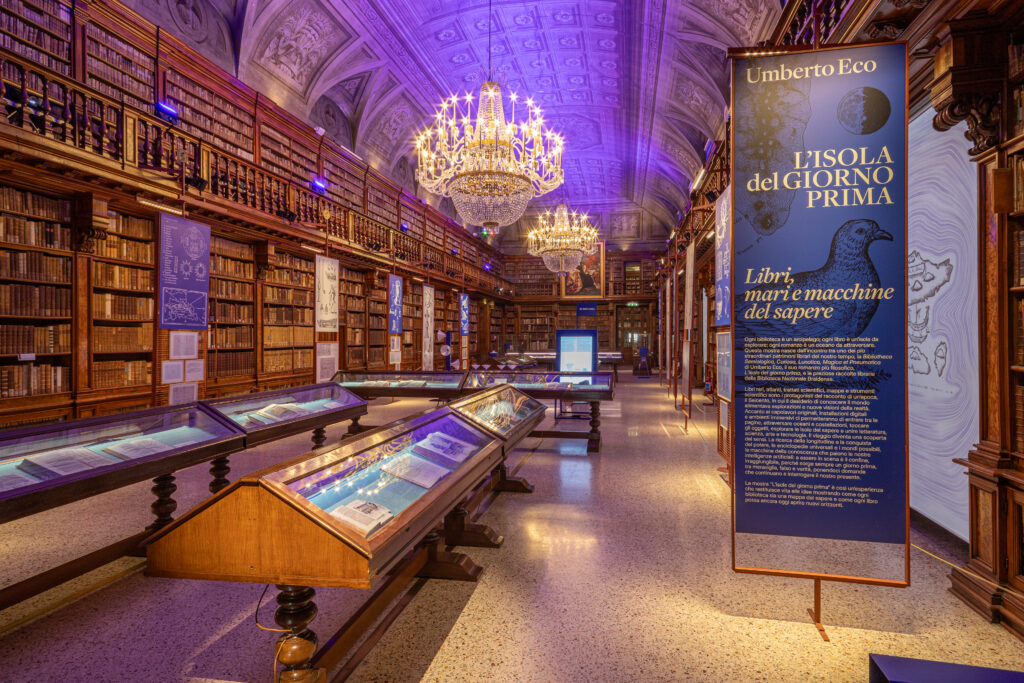
The exhibition steps into the workshop of The Island of the Day Before (1994) and makes visible the sources and mechanisms of the novel. At its centre are around seventy rare books drawn largely from Umberto Eco’s Bibliotheca semiologica curiosa lunatica magica et pneumatica: a collection of 1,328 volumes, including thirty-six incunabula, which occupied the “Room of the Ancients” in his Milan home.
Eco loved books that could speak not only of what we know, but also of errors, defeated hypotheses, curious sciences and the attempts — successful or otherwise — to impose order on the world. The exhibition brings this logic inside the novel: it opens its narrative machinery and lays bare its workings, setting books, manuscripts, instruments, objects, images, sounds and digital installations in dialogue with one another.
From Eco’s Library to the Ship Daphne
In the novel, books are not mere backdrop. The Daphne, the deserted ship on which Roberto de la Grive is shipwrecked, becomes at once a reading room, a laboratory, an observatory and a floating wunderkammer. The protagonist attempts to reach an island lying beyond the meridian that separates one day from the one before: the “island of the day before” — tantalizingly close, yet forever out of reach.
The exhibition performs the reverse movement: it sets out from real objects, books and working documents to trace back the construction of the novel. Among the masterworks on display are the Hypnerotomachia Poliphili (Venice, Aldo Manuzio, 1499), Ptolemy’s Almagestum (Venice, 1528), and Heinrich Khunrath’s Amphitheatrum sapientiae aeternae (Hanau, 1609) — a book that Eco also turned into a small bibliographical detective story.
How to read the exhibition: seven landfalls, seven groups of cases, seven sections.
Visitors are not invited to follow a single path. The seven sections function as islands or ports of call: one can enter at different points and encounter, each time, the same overarching themes — knowledge and imagination, measure and infinity, learning and power, true and false, memory and invention.
1. The Arts of Navigation and the Enigma of Longitude
Between the fifteenth and eighteenth centuries, oceanic exploration transformed the representation of the world and made one problem urgent: determining longitude — position east to west at sea. Astronomical and mechanical methods coexisted with fantastical proposals. The section shows clearly how a technical question can also become a political one: to measure space and time is to control routes, trade and power.
2. Unheard-of Curiosities and True False Beliefs
The seventeenth century is a laboratory in which new sciences and now-discredited beliefs coexist without clear boundaries. A telling example is the “powder of sympathy”: sympathetic it was not, in fact. Made from substances such as vitriol and gum, it was believed to heal a wound by acting not on the body of the wounded, but on the blood or the weapon that had caused it, even at great distance. This supposed capacity for action at a distance led to an even more surprising proposed use: signalling to a ship the exact time at its port of departure, and so contributing to the determination of longitude. The point is not to mock the past, but to observe how the credibility of an explanation is constructed, what evidence sustains it, and what, at a certain point, forces us to abandon it.
3. The Dream of a Universal Encyclopaedia and Artificial Machines
Between the sixteenth and seventeenth centuries, the ambition to gather and order all knowledge grew apace. Athanasius Kircher brought together observations, ancient sources, inventions and legends in a great inventory of creation. Alongside encyclopaedic repertories, combinatorial machines appeared: devices that could generate associations and sequences from a set of elements and rules. The exhibition uses this theme as a bridge towards contemporary questions about artificial intelligence — not conflating the technologies, but comparing the desire to automate the production of knowledge.
4. Theatres, Dreams and Images of the Marvellous
Giulio Camillo’s memory theatre imagines a space capable of making knowledge visible and traversable. Memory, images and the arrangement of elements become a mental machine. In the novel, Roberto’s exploration of the Daphne produces a similar effect: every object he encounters reactivates memories, associations and stories.
5. The Great Machine of Metaphors
For Baroque culture, metaphor is not mere ornament: it is an instrument of knowledge. Emanuele Tesauro’s Cannocchiale Aristotelico shows how unexpected juxtapositions can generate new relations between things. The exhibition insists on this productive dimension of language: to combine words and images is to construct possible models of the world.
6. Voyages, Sieges and Possible Worlds
Geographical discoveries transformed European experience and imagination. Travel accounts, reports from China, technologies from the East Indies, tales of imaginary lands and even extraterrestrial voyages coexist in an expanding cultural landscape. The novel also brings in war, sieges, strategies of power and the impossible love for Lilia: other forms of the desire to reach what remains beyond grasp.
7. The Inventory of Creation
To collect, name and classify the world is another great enterprise of the early modern period. Naturalistic taxonomies must distinguish between observation, testimony and legend, and transform a potentially infinite list into a legible order. The Daphne thus becomes a cabinet of wonders: birds, plants, corals, sea monsters, collections and repertories staging the human need to give form to the manifold.
The Writer’s Workshop
Alongside the rare books, preparatory materials from Eco’s archive are on display: index cards, drawings, lists of possible titles, opening lines, sketches of birds and instructions written for translators. These documents reveal the material precision of writing: before becoming images in the reader’s mind, many details of the novel passed through lists, diagrams and drawings.
Among the materials is a text by Luciano Berio: “Read it — better, listen to it: it is music.” A precious indication for approaching the novel through sounds, rhythms and timbres. The Daphne itself is a fluyt, a seventeenth-century Dutch merchant vessel — a name which, in the linguistic play so dear to Eco, also carries the resonance of the word for “flute.”
The Digital Visualisation
On the walls of the Sala Maria Teresa, five islands drawn from antique prints are projected, surrounded by streams of words generated from thematic clusters. The conceptual pairs are: artificial/natural, list/inventory, invention/discovery, measure/infinity, power/knowledge.
The installation translates into visual form a central question: words can bring us closer to an object, but they cannot exhaust it. The automatic flow should not be mistaken for self-sufficient truth: context, an interpreter and a reader capable of establishing limits and relations are all required. In this sense, the device opens an explicit reflection on the contemporary use of generative systems.
The Blue Artefacts: Reading with the Senses
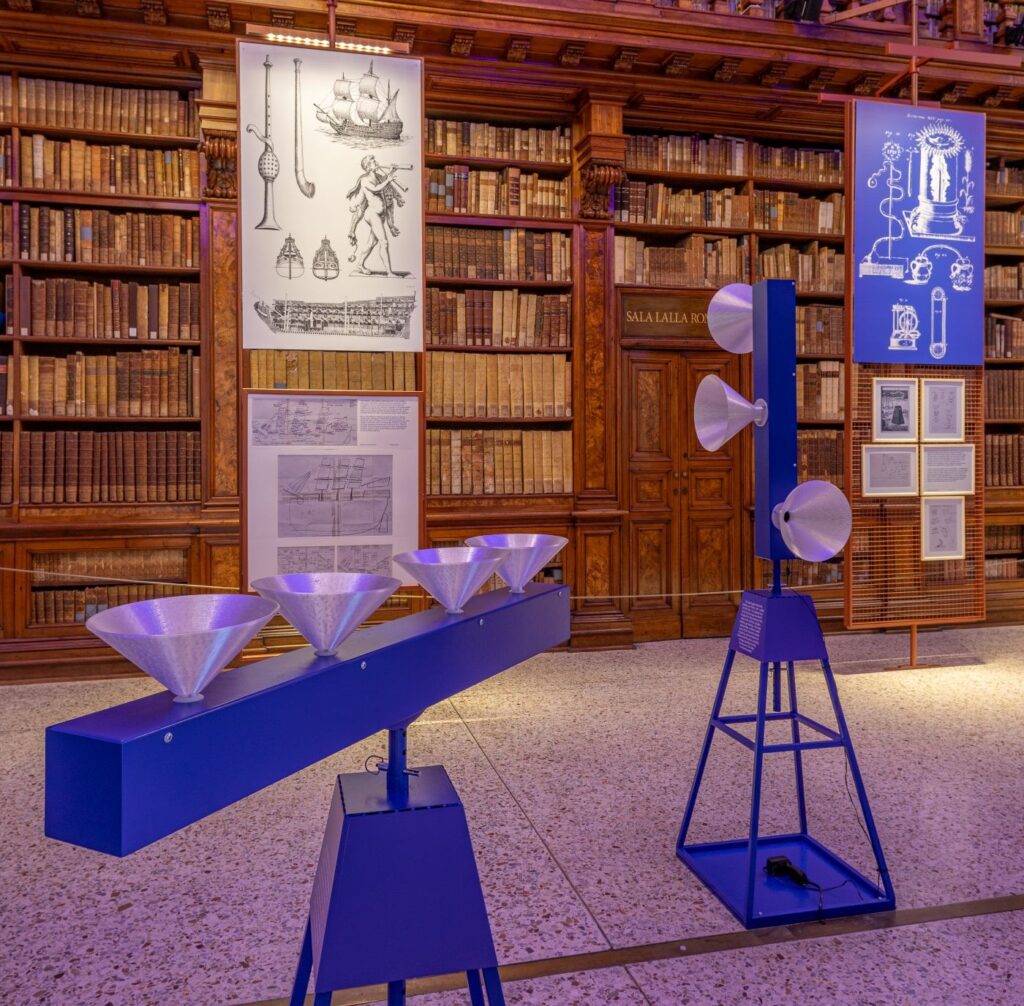
The blue metal artefacts, designed by XyComm, invite above all younger visitors — though not only them — to enter the novel through a sensory and playful experience.
Throughout the exhibition, navigational and astronomical measuring instruments on loan from the Museo Galileo of Florence are on display: a quadrant, a nautical compass, a nautical astrolabe, a sundial, a replica of the jovilabio for Jupiter’s satellites, and a replica of Galileo’s telescope. Alongside the scientific instruments appear deliberately eccentric objects: a flute, the powder of sympathy, naturalistic curiosities, anatomical prints, comics and references to characters beloved by Eco. These are “detours” that interrupt linear readi
The Machine of Metaphors
The rare books displayed in the cases are objects to be looked at — but above all they are books to be read. For this reason, the exhibition includes a digital screen through which visitors can leaf through some of the most significant pages of the volumes on show, going beyond the necessarily fixed opening chosen for display. The screen allows visitors to engage with the materiality and richness of these books: illustrations, diagrams, maps, alphabets, title pages, graphic apparatus and pages in which text and image together construct knowledge. It is not simply a consultation tool, but another way of entering the library that lies behind the novel and of observing more closely the visual and conceptual sources with which Eco worked.
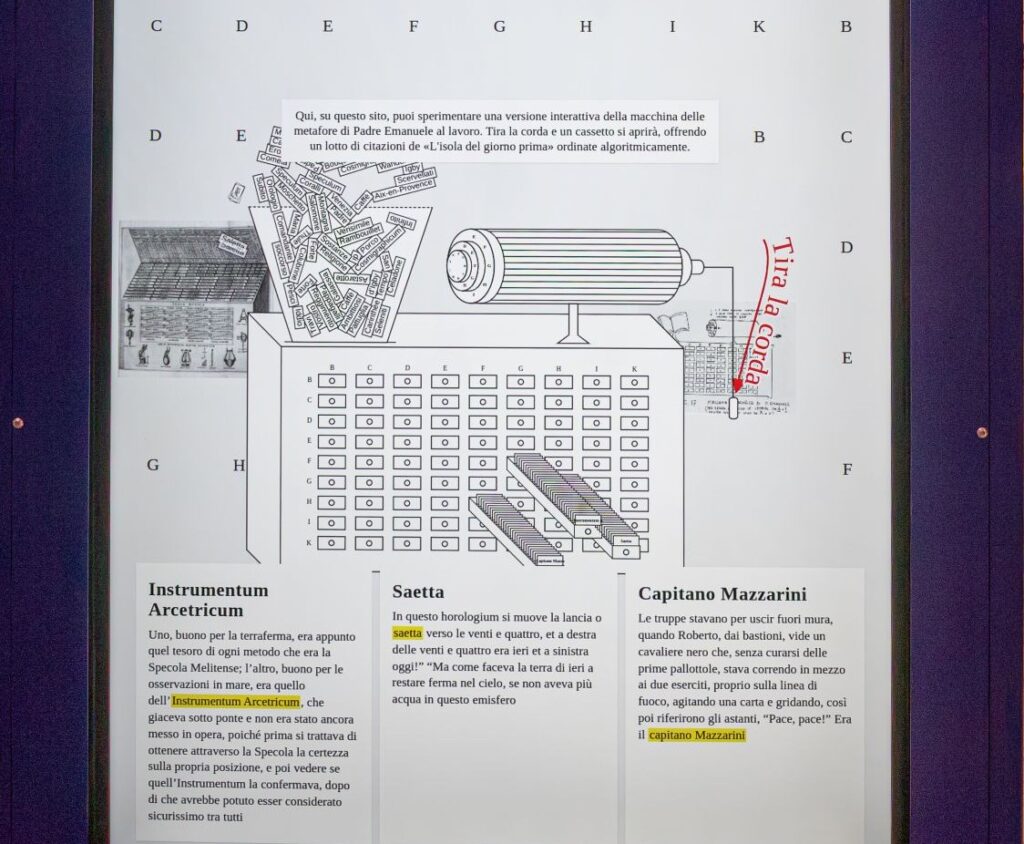
To leaf through a book is also to perform a gesture that is essential to this exhibition: moving from the object on display to the book as an active mechanism, capable of generating associations, images and stories. Behind this screen lies the Machine of Metaphors — a literary device that treats writing as a combinatorial operation. Working from a finite set of words and rules of association, it generates combinations that echo passages from the novel and its sources. The historical reference is to the tradition of Lullian wheels, classifications and combinatorial encyclopaedias.
The decisive point is that combination does not replace judgement. The machine can assist, suggest and multiply possibilities; it cannot decide on its own what is relevant, true or meaningful. This is one of the places where the exhibition’s historical narrative engages most directly with the questions raised today by artificial intelligence.
Braidense National Library, Sala Maria Teresa
(two entrances: one from the Braidense Library and one from the Pinacoteca Brera)
2.10 2026 – 10.01.2027
Free admission; no reservation required
- Monday: 9:30 a.m. – 6:00 p.m. (access only through the Library; last entry at 5:30 p.m.)
- Tuesday through Friday: 9:30 a.m. – 6:00 p.m. (last admission at 5:30 p.m.)
- Saturday and Sunday: 9:30 a.m. – 6:00 p.m. (entry only through the Pinacoteca di Brera; last admission at 5:30 p.m.)
Click here to discover the workshops open to everyone (in Italian language).
GUIDED TOUR (in Italian language) Click here to learn about guided tours for teens and adults.
EVENTS (in Italian language) Click here to learn about the conferences for young people and adults.
Happens in Braidense
Biblioteca Nazionale Braidense offers a rich panorama of events, lectures, presentations, conferences. Discover the calendar of our activities.

L’isola del giorno prima
An exhibition and educational project designed to highlight the work and ideas of Umberto Eco.
READ MORE +